

3 Mountain Biking Destinations in the US and What Riders Should Know
Just a quick observation on social media shows how much people enjoy those highland regions, which have become a paradise for adrenaline-fueled sports activities. One of the most active groups is athletes who enjoy mountain biking, either as pros or amateurs. We prepared a tight list of regions they will love to discover, along with some additional advice on what to know about them.
How to judge a trail town before you go
The first thing to study is the surface. Mountain biking changes shape when the ground changes. Slickrock gives you huge grip until it does not, and that means smooth pedal strokes and quiet braking matter more than brute force. The rooty forest trail is different. There, the front wheel needs room to move, your hands need to stay calm, and your eyes need to look farther ahead because traction can shift from one bike length to the next. Machine-built flow trail asks for another skill set again. It rewards timing, pumping, and carrying speed through corners without wasting effort.
All these are part of adrenaline-fueled sports, and if you ever encounter episodes of the Team Ignition podcast, many of their interviewees explain important details about their activity. When you listen to different athletes talking about almost the same things, including the importance of timing, you realize that such subjects are essential for many sports.
For biking in particular, the next important thing to study is how the miles are built. Ten miles can be easy or draining depending on climb rate, trail width, and how often you need to reset after technical features. A strong trip starts with reading elevation gain per mile, average ride length, and how easy it is to shorten the route if weather or fatigue changes the plan.
Mountain biking at destination level is really a matter of energy control. Riders who pace the first climb, hold something back for late technical sections, and treat day one as a calibration ride usually get more from the trip. Actually, for those who are interested deeply in the hobby, the show with Kyle Strait can be valuable:
Bike setup is important too, and so is the knowledge that a bike has a 10% depreciation rate. You want to take care of it very well and make it serve you as long as possible. Rocky trails usually need:
- firmer support,
- careful tire pressure,
- and strong tire sidewalls.
Forest trails with roots and wet ground often feel better with:
- a softer setup,
- and tires that grip well in turns.
Fast trail centers make brakes and cornering more important than having the biggest suspension. You do not need to rebuild the whole bike, but to be honest about the trail, your bike, and your own riding strengths.
Three U.S. stops that reward different riding styles
These three destinations stand out because each one has a clear ride pattern. One is built around rock and precision. One makes it easy to stack short sessions and repeat laps. One rewards fitness, patience, and comfort on longer forest routes.
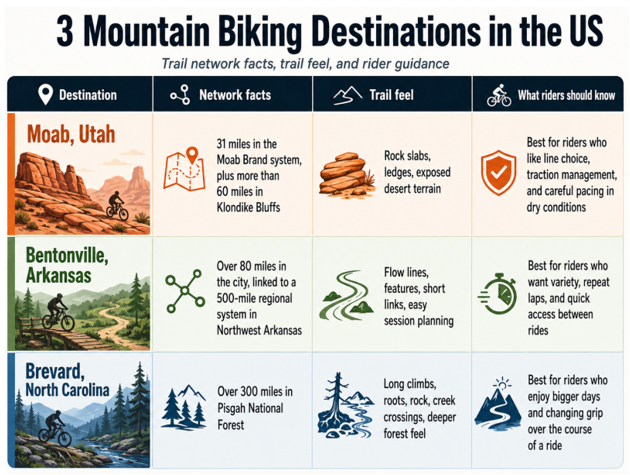
The mileage figures and trail descriptions above come from official land and destination sources. Read them as a guide to trip shape, not as a ranking. Moab favors precision and heat planning. Bentonville, which is relatively a new city, suits well for riders who want to progress fast because the trail density keeps wasted time low. Brevard suits riders who are comfortable turning a ride into a full day out, with more climbing and more trail texture to manage.
Full trail networks matter more than one famous route
A destination lasts when it offers a system, not one famous line. That is important for riders and for the towns around the trailhead. A 2025 Trust for Public Land and IMBA review found that nonlocal visitors spent an average of $416 per trip across the studied destinations, and that trail networks in 13 locations generated up to 1,626 jobs and $54.1 million in labor income each year.
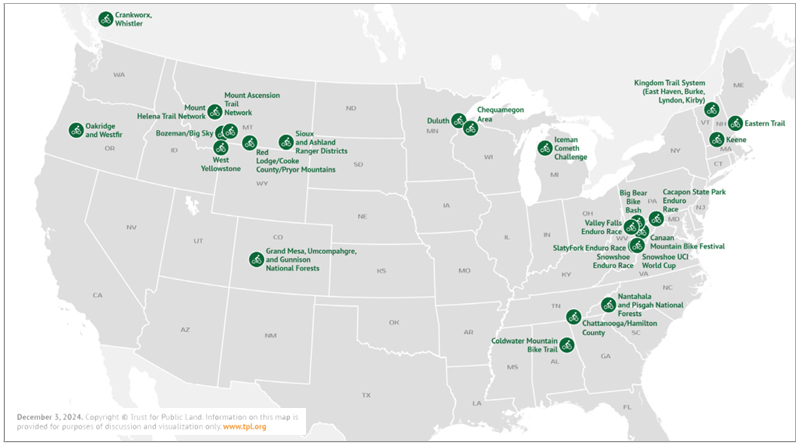
This map supports the point that riders are usually choosing between distinct trail ecosystems, which is why places like Brevard or Moab stand out for very different riding experiences.
In a related Trust for Public Land article, J.T. Horn, the group’s national trails director and a lead author of the report, said, “With thoughtful planning and investment, trails can become powerful engines of prosperity and well-being.”
That pattern also explains why riders remember some places more clearly than others. A full network gives you options. You can ride hard in the morning and spin easy later. You can change plans when storms move in or when your legs are flat. Mixed-skill groups have a better chance of sharing a trip without forcing everyone onto the same kind of ride. The destination becomes useful, not just famous.
For the rider, this usually makes the trip better. You spend less time driving, less time guessing, and less time trying to make one famous trail carry the whole visit.
- your mood,
- your fitness level,
- and the weather that day.
That is what turns a good trail town into a place riders want to visit again. Pick the place that fits how you ride now. Moab, Bentonville, and Brevard all deliver, but each one asks for a different kind of judgment, setup, and effort.