

How B2B Crypto Payments Work
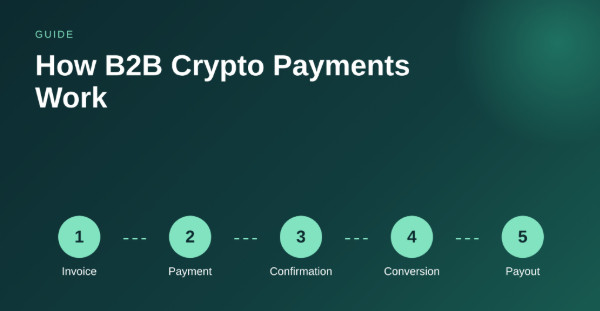
B2B crypto payments are transfers between companies that settle on a blockchain instead of moving through a chain of correspondent banks. The flow has five steps: the supplier issues an invoice with a crypto amount and a wallet address, the buyer pays on-chain, the network confirms the transaction, the funds are converted if needed, and the supplier pays out to a bank account or another wallet. Many teams settle in stablecoins such as USDT and USDC, because price swings between invoice and payment are rarely welcome. This guide walks through each step, compares the route with SWIFT, and covers compliance, risks, and the mistakes teams make first.
How B2B Crypto Payments Work, Step by Step
Provider names for these stages differ, but the logic is the same everywhere.
1. Invoice
Crypto invoicing for businesses starts like any invoice: amount, due date, payer. The difference is the payment instruction. It names an asset (say, USDC), a network (say, Polygon), and a wallet address or payment link generated for that specific invoice. One address or reference per invoice lets accounting match each incoming transfer to the right bill.
2. Payment
The buyer sends funds from a company wallet or an exchange account. Asset, network and address must all match the instruction. A token sent on the wrong network may never reach the supplier, and nobody can pull it back for you.
3. Confirmation on the network
Validators include the transaction in a block. Payment processors usually wait for a set number of confirmations before marking the invoice as paid; the number depends on the network and the provider's risk policy. Once that threshold is met, the provider treats the transfer as settled. Finality rules differ between networks, so ask your provider which one it applies.
Crypto has no chargeback mechanism. A refund is a new, separate payment that the supplier decides to make.
4. Conversion
Many suppliers do not want to hold crypto. A processor can convert the received amount into a chosen currency automatically or on request. This is where the exchange rate and any spread matter, so ask how the rate is set before you sign up.
5. Payout
The supplier withdraws to a bank account through an off-ramp, sends funds to another wallet, or pays its own vendors directly in stablecoins. A payout to a bank account still runs through the banking system, so bank hours and local checks can apply at this step. For many companies, payout decides whether the whole setup is practical.
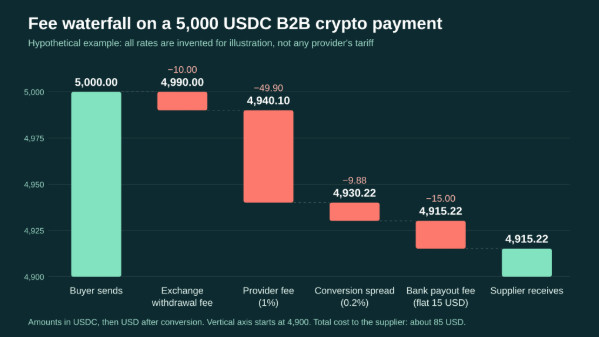
Hypothetical example, with every rate invented for illustration and not taken from any provider's tariff:
The buyer sends 5,000 USDC; after the buyer's exchange takes a 10 USDC withdrawal fee, 4,990 USDC arrives.
The provider charges a 1% fee and credits 4,940.10 USDC.
Conversion to USD at a 0.2% spread leaves 4,930.22 USD.
A flat 15 USD bank payout fee means the supplier receives 4,915.22 USD.
Each step is small, but together they cost the supplier about 85 USD on a 5,000 invoice. Ask for every fee in the chain before you quote a price.
B2B Crypto Payments vs. SWIFT Transfers
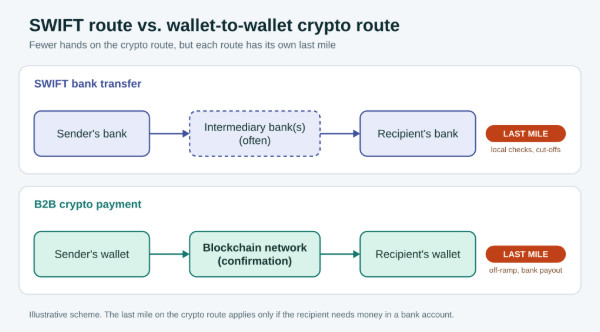
Both routes move value between two companies in different countries. They differ in how many hands touch the money and when each hand is open for business.
Stage | SWIFT bank transfer | B2B crypto payment |
Payment instruction | Beneficiary name, bank, account number | Wallet address, asset, network |
Route | Sending bank, often intermediary banks, receiving bank | Sender wallet to recipient wallet on a blockchain |
Availability | Bank operating hours and local cut-offs | Blockchains run around the clock; conversion and bank payout depend on providers |
Confirmation | Status messages and bank notifications | On-chain confirmation visible to both sides |
Currency conversion | By banks along the route | By the processor, or not at all if both sides accept the same stablecoin |
Last step to the recipient | Local processing at the receiving bank: reporting, FX controls, manual checks | Off-ramp and bank payout, or none if the recipient keeps stablecoins |
Reversibility | Recalls and investigations go through the banks | No card-style chargebacks; the supplier can refund by sending a new payment |
Compliance checks | Bank KYC and sanctions screening | KYB with the provider, plus transaction monitoring |
The honest picture is more nuanced than "crypto is faster." The Financial Stability Board names four long-standing problems in cross-border payments: high costs, low speed, limited access, and insufficient transparency. On speed, Swift's own data shows that most payments reach the beneficiary bank within minutes. The delays pile up afterwards, in regulatory reporting, operating hours, FX controls, and manual processing at the receiving bank. Swift says these local steps can stretch the whole journey to hours or, in some cases, days.
A crypto route has its own last mile. If the supplier needs money in a bank account, the off-ramp and the bank payout add their own timing. So the real advantage of cross-border B2B payments in crypto is structural: fewer intermediaries, settlement at any hour, and a transaction record both parties can check. The trade-off sits at the edges. Moving between fiat and crypto still depends on on-ramps, off-ramps, and the conversion rate you get.
Who Should Use Crypto for B2B Payments, and What Can Go Wrong
Where it fits
Crypto settlement tends to work for companies that pay or get paid across borders on a regular basis: digital agencies, software teams, game studios, and online platforms with international suppliers. It also suits businesses that already hold stablecoin balances, and invoices that need settling outside bank hours.
It fits poorly when the counterparty cannot or will not receive crypto, when finance has no process for booking on-chain payments, or when payments are so rare that onboarding costs more than the friction it removes.
If you are past the concept stage, a detailed guide to b2b crypto payments integration covers the engineering side of the setup in depth. When comparing b2b crypto payment solutions, check the supported assets and networks, how conversion and payout work, the fee structure, reporting for accounting, and what the provider requires from your company.
Price and issuer risk
Bitcoin and Ether can move sharply between invoice and settlement. Stablecoin B2B payments remove most of that swing, but not all risk: you still depend on the issuer and its reserves, and a stablecoin can lose its peg. Decide in advance which asset you accept and how quickly you convert.
Compliance: KYB, KYT, and AML
Three terms come up constantly:
KYB (know your business): the provider verifies your company, its owners, and what it does before activating an account.
KYT (know your transaction): incoming and outgoing transfers are monitored for risky sources and counterparties.
AML (anti-money laundering): the wider programme of policies and reporting that wraps around both.
These rules are not an afterthought. The FATF's guidance on virtual assets says providers should be licensed or registered and supervised, and it covers stablecoins and the "travel rule" on sharing sender and recipient information. The FATF sets international standards, while the actual obligations come from national law, so they differ by jurisdiction. The same goes for taxes. The guidance dates from October 2021, and the FATF itself notes that it does not reflect later revisions to its standards.
This is general information, not legal or tax advice; check your own situation with a local professional.
Common Mistakes in B2B Crypto Payments
Sending on the wrong network. The same token exists on several chains. Put the network next to the address on every invoice, and send a small test amount first on a new route.
Ignoring network fees on the payer's side. Hypothetical example: you invoice 5,000 USDC, and the buyer's exchange deducts a withdrawal fee from the amount, so 4,990 arrives. The invoice sits as "partially paid" until someone chases the difference. Agree who covers network costs, and say so on the invoice.
No plan for payout. Receiving crypto is the easy part. Decide beforehand whether you convert automatically, hold, or pay vendors directly, and test the off-ramp to your bank before the first large payment.
Skipping counterparty and transaction checks. An address that looks fine can be linked to a sanctioned or high-risk source. Screening is cheaper than freezing a payment later.
Forgetting that finality cuts both ways. Without chargebacks, a wrong address or a disputed delivery cannot be fixed by a reversal. Put refund and dispute terms into the contract.
How an Accelerator and Its Startups Can Use B2B Crypto Payments
Early-stage B2B companies often land their first foreign client before they have a payment setup that works across borders. Building one costs engineering time that a young team would rather spend on the product. Here is how a partnership around that gap could look. It is a model, not a description of any signed agreement.
One example of a ready payment layer is the platform at inqud.com. Inqud is a crypto payment platform for businesses: it covers accepting crypto payments, conversion, payouts, on-ramp and off-ramp, and has an OTC desk. Teams can connect through an API, an iFrame widget, or a hosted payment page. According to the company, technical integration can take about two days. Business accounts also need KYB verification, which comes on top of that figure. Supported assets include BTC, ETH, USDT, and USDC, across networks such as Tron, Bitcoin, Solana, Optimism, Arbitrum, and Polygon. Received funds can be converted automatically into a chosen currency.
What each side could get
The accelerator adds value for its portfolio without building or maintaining a payment product of its own.
The startups get payment infrastructure from day one: invoices, payment links, conversion, and payouts for their first international customers. By the company's description, there is no monthly fee and commissions are charged per transaction, with individual rates available for larger volumes. Check the current tariff page for the exact fees on receiving, conversion and withdrawal. Payments between participants inside the Inqud system carry no commission. Any terms specific to an accelerator partnership are outside the scope of this article.
Inqud gets access to a group of young B2B products and direct feedback from the teams that use it, which can inform its product.
For a startup with subscription clients, recurring payments with automatic debit from a linked Web3 wallet may matter more than one-off invoices. Developers who want their own checkout can use the SDK, and an MCP server exposes the API documentation.
FAQ
Are B2B crypto payments legal? In many countries, yes, but the rules differ by jurisdiction. Providers are generally expected to follow AML and licensing requirements, and your company may have its own reporting and tax duties. Check local rules before you start.
Can a B2B crypto payment be refunded? Yes, but not the way a card payment is. The supplier can issue a refund by sending a new payment, while the payer cannot trigger a card-style chargeback on an on-chain transfer. Agree on refund terms in the contract.
Do I need to hold crypto to get paid in crypto? Not necessarily. A payment processor can convert incoming crypto into a currency you choose, so your balance never has to sit in crypto. Compare the conversion rate and fees first.
How long does a B2B crypto payment take? It depends on the network, the confirmations your provider requires, and any conversion or bank payout afterwards. The on-chain step is often the quickest part, while a bank payout can take longer depending on the bank and the route.
Which crypto is best for B2B payments? There is no single answer, and this is not investment advice. Many companies prefer stablecoins because the amount stays stable between invoice and payment. The right choice depends on what your counterparty accepts and which networks both sides can use.
Conclusion
B2B crypto payments replace a chain of intermediaries with a wallet-to-wallet transfer, then add conversion and payout on top. They help most with international suppliers and clients, odd hours, and traceable settlement, and they bring their own demands: network discipline, volatility and issuer risk, KYB, and transaction monitoring. Treat the on-ramp and off-ramp as part of the payment, test a small transfer first, and write refund terms into the contract.