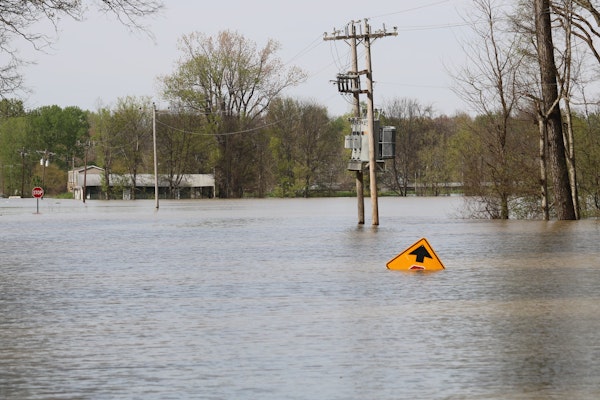
Two of the worst U.S. floods in 2022 ravaged homes, destroyed businesses and forced residents to evacuate for weeks. But homeowners in Florida and Kentucky are getting wildly different payments from a federal flood insurance program crucial to rebuilding and recovery.
Countless thousands of Americans this month found themselves racing for cover, fretting about cars and roofs, and covering their ears from the deafening roar of heavy hail. Time and again this spring, and especially during June, a relentlessly locked-in-place weather pattern has driven intense severe thunderstorms from the High Plains across the South and Midwest.
The insurance industry is increasingly wary of the risks presented by climate and natural disasters, prompting major firms to scale back their presence in more vulnerable states.
A recent analysis reveals that the federal assessment of extreme rainfall is significantly underestimating the likelihood of flood events, raising concerns about infrastructure development, flood insurance costs, and public safety.
When a NatCat occurs in Canada, it’s common for U.S. adjusters to be on the scene -- sometimes before Canadian adjusters, who are bound by provincial licensing restrictions.<br /><br />And while processes for getting either country’s adjusters on the scene are complicated, Canadian adjusters are now benefitting from technology and following U.S. adjusting processes more closely.<br /><br /><br />But there’s still room for improvement.<br /><br />It can be easier to mobilize adjusters between countries than in their respective countries thanks to the Agreement between the United States of America, the United Mexican States and Canada (USMCA), which replaced the North American Free Trade Agreement in 2020, said David Repinski, CEO at CRU Group.<br /><br />The agreement is designed to reduce trade barriers among the three countries and makes it easier for Canadian insurers to bring in U.S. claims adjusters.
There are few for whom I have more respect than soldiers. Those men and women who choose to put themselves to the test in unimaginably difficult ways under extreme conditions, who risk life and limb in the service of their country, and who stand guard over liberty have my highest respect and deepest thanks.
The future insurability of Florida hurricanes is in question because of storm severity, the state’s storm-exposed coastal topography and development patterns, and Florida’s high-cost legal environment. These factors combine to make coverage for hurricane risks in Florida the most expensive in the country.
The Central Pacific hurricane season has started, and this year, the Nature Conservancy has purchased $2 million in insurance coverage to protect against potential damage to the coral reefs in Hawaii.
Floods pose a severe threat to communities across the United States, causing extensive property damage and potential risks to human life. Recognizing the importance of identifying flood-prone cities, Insurify developed a flood risk score, taking into account FEMA’s risk scores for coastal and river flooding, population data, average home insurance premiums, and average home values.
The National Oceanic and Atmospheric Administration (NOAA) announced on Thursday morning that El Nino, the powerful ocean and atmosphere cycle in the tropical Pacific, has officially resurfaced after a hiatus of approximately four years. El NiÃ,o plays a significant role in shaping global weather patterns and has the potential to amplify extreme weather events worldwide.
Many of the nation’s disaster organizations are exposed to perilous financial risks at the start of hurricane season, jeopardizing efforts across much of the U.S. to recover from catastrophes.
The 2023 Atlantic hurricane season officially started June 1 and is forecast to be a busy one, which is why homeowners need to prepare. Yet many lack even the most basic preventative measures, unaware of the risks they face, according to a new survey by Triple-I, in coordination with Munich Re.
CoreLogic Inc. said Thursday that more than 33 million U.S. properties are at risk of hurricane-force wind damage and that there is $11.6 trillion of total reconstruction cost value at risk nationally for the 2023 Atlantic hurricane season.
The National Oceanic and Atmospheric Administration (NOAA) has released its annual forecast for the upcoming 2023 Atlantic hurricane season, set to begin on June 1.