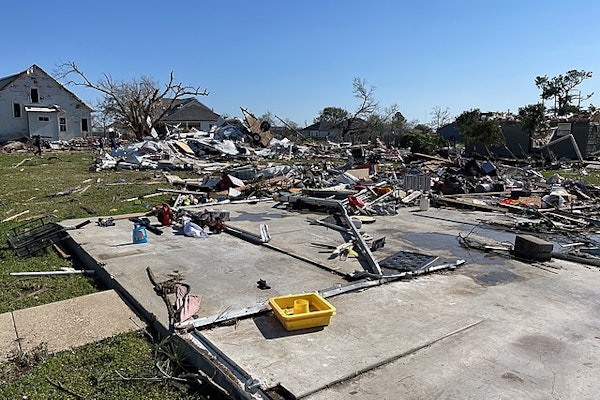
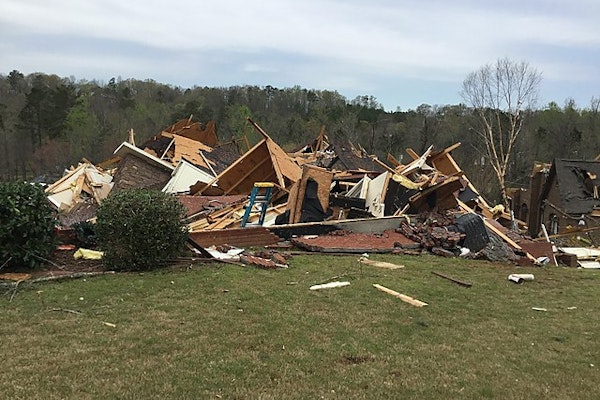
The severe convective weather, thunderstorms, large hail and tornadoes that affected the United States this week is expected to aggregate to drive hundreds of millions of dollars in insured losses, according to Aon’s Impact Forecasting.
Louisiana’s governor declared a state of emergency on Wednesday after tornadoes sliced through the New Orleans area Tuesday night, lifting homes off their foundations, leaving thousands without power and killing at least one person.
Dr. Ted (Tetsuya) Fujita created a tornado damage scale in 1970 after the Lubbock, Texas tornado. The damage scale was divided into six categories where F0 corresponded with minor damage to houses with estimated winds of 40 - 72 mph (18 – 32 m/s) all the way up to F5 where strong frame houses were swept off their foundations in estimated winds of 261 - 318 mph (117 – 142 m/s).
The Intergovernmental Panel on Climate Change (IPCC) has been publishing assessment reports describing expected climate change impacts and risks since 1990 and has warned of the growing risks from climate change in each report.
Researchers have used artificial intelligence to predict where flood damage is likely to happen in the continental United States. The findings suggest that recent flood maps from the Federal Emergency Management Agency do not capture the full extent of flood risk.
Deaths related to flooding hit a five-year high in 2021 – the third-highest count since 2010 and the highest since 2017 – according to National Weather Service (NWS) data. Perhaps the saddest aspect of last year’s 145 fatalities is the fact that a majority were preventable.
Analysts at CoreLogic, a global provider of property information, analytics, and data-enabled solutions, have released a new report which reveals that over 14.5 million single and multifamily homes were impacted by the largest natural catastrophe events of 2021, with an estimated $56.92 billion in property damage.
Global insurance and reinsurance market losses from natural catastrophes and severe weather events were almost five times the ten-year December average, as the impacts of the US tornado outbreak and Colorado wildfires continued to put the pressure on re/insurers, according to analysts at investment bank Jefferies.
Another insolvent insurer in Louisiana has been placed into receivership, as the company continues to grapple with massive pending hurricane claims. Louisiana insurance commissioner Jim Donelon placed Americas Insurance Company (AIC) into receivership in the 19th Judicial District Court.
Too many houses built too close together on the tinder-dry high plains between Denver and Boulder led to the record Marshall firestorm losses topping $1 billion, insurance industry researchers found this week as they sifted through ashes and charred ruins.
AM Best has warned that demand surge and inflation will amplify losses related to the December 30th, 2021, late-season Marshall Fire in Boulder County, Colorado, which destroyed more than 1,000 structures.
Insured losses of $44 billion from COVID-19 so far represent the third largest cost to insurers of any catastrophe, behind Hurricane Katrina and the 9/11 attacks, insurance broker Howden said on Tuesday.
The late-season Marshall Fire in Boulder County, Colorado, which destroyed almost 1,000 structures after strong winds accelerated the spread, is estimated to have resulted in insured losses of approximately $1 billion, according to risk modeller Karen Clark & Company.
Devastation from tornadoes that slammed parts of the United States this month will push the insurance industry’s 2021 bill for weather-related claims well above the predicted $105 billion, industry experts said, and premiums should rise on worries that climate change will drive more severe weather.
Analysts at Jefferies have reported that insured natural catastrophe losses are running 48% higher than the long-term average, as of the end of November, and 34% above the 10-year average.